
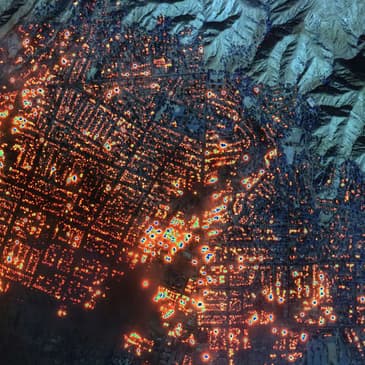
This episode is a conversation with Jonathan Rosenbloom, Associate Dean at Albany Law School who has researched and written about sacrifice zones. He is also the Executive Director for the Sustainable Development Code.
We discuss:
- Whether neighbourhoods that have been destroyed by natural disasters should be rebuilt or designated as no-build 'Sacrifice Zones'.
- How US planning departments can use the Sustainable Development Code to ensure new development is low carbon and climate adapted.
Note: This episode was recorded before the LA wildfires in January 2025.
Links:
Contact Jonathan: jrose@albanylaw.edu
Sustainable Development Code: https://sustainablecitycode.org/
Article on Sacrifice Zones: https://nextcity.org/urbanist-news/the-case-for-returning-disaster-prone-areas-back-to-nature
- - -
Subscribe to the Green Urbanist Newsletter
GatherMap - Interactive crowdsource mapping tool
The Green Urbanist podcast is created by Ross O'Ceallaigh.
[00:00:00] When people think about political activism or involvement in government or in their own community, I think land use ends up being really low on the list, but it should be really high on the list. It really affects so much of what we do in our daily lives. I mean, when we step out our door, much of it is not about free will.
[00:00:30] Welcome to The Green Urbanist, a podcast for urbanists fighting climate change. I'm Ross. My name is Jonathan Rosenblum. I am a professor of law and associate dean at Albany Law School and the executive director of the Sustainable Development Code.
[00:00:55] This episode with Jonathan is quite a wide ranging conversation. We talk a lot about how local planning authorities in the US can use coding and in particular something he's developed with colleagues called the Sustainable Development Code to ensure that new development is low carbon and climate adapted and specific for the sustainable development code. For their context and local climate. But perhaps the most timely part of the discussion that we had was around the idea of sacrifice zones.
[00:01:25] It's a quite a scary sounding term, but sacrifice zone is this idea that after an area has been destroyed or damaged by a natural disaster or if it's at a high risk of a natural disaster, this idea that some areas, instead of being rebuilt as they were before, are actually left as a buffer between natural disasters or high risk of natural disasters and built up areas like towns and cities.
[00:01:55] And this idea that parts of our cities and our suburbs and our suburbs and our neighborhoods could sort of be returned to nature in a sense. Those areas could be decommissioned, the buildings could be removed and they would be allowed to rewild in a sense. And the idea is that this would bring a level of resilience to the rest of the built up area.
[00:02:18] But it would also mean that the people who would move from those disaster prone areas would be much safer by being relocated or choosing to relocate somewhere else. This was recorded in December 2024. So quite soon before the LA wildfires in January 2025, which is why we don't mention that in the episode. But we do talk about wildfires in general.
[00:02:45] And the fact that I'm releasing this now, just as I think over 100,000 people have been made unhoused essentially by this incredible wildfire that has ripped through LA is, yeah, it's a very timely discussion. And, you know, it's not something that we talk about lightly. It's quite a difficult topic. It's a very emotive topic.
[00:03:07] But I think these are the kind of difficult conversations that need to be had during this time of climate crisis where some neighborhoods just won't be safe to live in anymore. And we've seen that sometimes very large parts of cities are not safe to live in.
[00:03:26] And so we need to, you know, going forward in LA, but also in Spain where there was massive flooding in the summer and all over the world where there is natural disasters like this, there is difficult conversations like this that need to be had to think about what are the options with the goal of averting loss of life first and foremost. So I hope this is an interesting and enlightening and thought-provoking conversation.
[00:03:54] And I hope the rest of the conversation, which is about slightly more mundane things around coding and local planning powers, is also useful, particularly for those of you based in the US. If you have any thoughts on this topic, I'd love to hear from you. You can also contact Jonathan. His email address is in the episode description, the show notes. But there's also a link in there to my contact page and my website. So you can send me a message as well. I'd love to hear from you and hear what your thoughts are on this.
[00:04:25] For those of us, those listening and people like me who are not in the US, you tell us a little bit about the US coding system and what that is. And then maybe that'll take us into why you came up with the Sustainable Development Code. Yeah. And actually the question is a really good one because it starts to frame why we came up with the Sustainable Development Code. So in the United States, we have over 36,000 local governments. So these are towns, counties, cities, parishes.
[00:04:55] Each of these towns, cities, counties, parishes has the ability to regulate land. And they get that authority because it resides with the states. So in the United States, there's 50 states. Each of those states then delegates land use authority to these local governments. And from there, it all just sort of got fractionalized.
[00:05:18] And so now we have thousands upon thousands of these local governments that are regulating land use, even though they're facing the same problems or very similar problems in many instances. So I guess so it's and in terms of how it works in practice, it's very much a spatial plan based system, isn't it? Where the local government is setting out what can happen where in terms of development. Is that right? Yeah, that's for the most part right.
[00:05:45] I mean, it's an interesting process because in many ways, it's like the combustion engine for the car and that it's been stuck where it is for the last hundred years. Right. I mean, now we're starting to see EVs and all this kind of development. Right. But for the most part, the combustion engine is what we see on the roads. And that's the same similar combustion engine we still that was there, you know, a hundred years ago. Well, it's very similar with zoning.
[00:06:10] Zoning really came about in the United States kind of coming out of the 19th century and into the early 20th century. We started to see these kind of one off challenges where development out of cities where they were growing rapidly. People were moving to cities. We're starting to create these conflicts between the growth of the residential areas and existing agricultural or industrial areas. And so we started to have all these conflicts.
[00:06:38] So some cities started to pass these one off zoning. And as cities continue to develop, ultimately, New York City in 1916 said, well, we're going to get a comprehensive zoning code that regulates all of the areas across the city. But to kind of come back to your original question, yeah, it's almost like a two-stage process. And it's really oversimplifying it.
[00:07:05] But the two stages are, number one, we as a city, as a community, are going to come together and figure out what do we want to look like in terms of our land use, in terms of the way that we interact with each other or don't interact with each other is really what happens. But what do we want to have here in our community for the next 20 years? That's called comprehensive planning. And in many ways, that's the first sort of step to getting a zoning code.
[00:07:35] After that, or as part of that, then local governments have their zoning laws that are supposed to put into place the actual laws and regulations that are based on the comprehensive plan. Now, in practice, of course, it doesn't actually play out that way. Like not everything, but like a lot of law, it doesn't play out that way. But what we have is we have comprehensive planning continuing to be revised every 5, 10, 20 years. That depends on state law.
[00:08:04] And then we have zoning codes that are updated sort of one-off, right? Like a zoning code can be 300 pages long, but there will be like, okay, we have to change this little piece over here. We want to tinker around this here. But, you know, and I just want to make one more point about this, which is that undergoing a zoning rewrite is a significant endeavor. And so you have, again, you have these thousands and thousands of local governments.
[00:08:31] Many of them have their original zoning code from the 1940s or 50s or 60s or 70s, even 80s and 90s. That's the base of their code. And all they've been doing over the past, you know, 40, 30 years has been doing these one-off updates. But you think about the world around us and it is so dramatically changed, whether we're talking about climate change or wildlife, biodiversity, water.
[00:08:59] I mean, everything has so dramatically changed that trying to figure out how to fit that into an existing zoning code that is decades old is a real problem and a real struggle. And again, we have thousands of these local governments that are struggling with this. Just a quick break.
[00:09:25] As a thank you for being a podcast listener, I'm offering you a 10% discount on my course, Sustainability Essentials. If you're new to sustainability or you're a specialist, but you want to broaden your understanding, then this is the course for you. It will help you kickstart your journey so that you can make a positive impact through your work as a built environment professional. To learn more and enroll, go to the episode description and click the link to the course page. Okay, back to the episode.
[00:09:58] That's really, really clear. Thank you for that. And I think you've, you know, flagged up some of the key challenges with that sort of a system. I think some of the other criticisms I've read about its typical US zoning system is it can be used to sort of stratify society in a way. So you have broad areas that are sort of single family homes, which are sort of middle class areas. And then you have other parts of the city, which are more like cheaper apartments where you're having, you know, people who are less affluent.
[00:10:27] Whereas obviously, you know, one of the key things of, we'll say, more equal or equitable planning would be having more mixed communities where people are sort of able to be in these more mixed use, mixed tenure sort of parts of cities. And maybe more how historic cities would have grown. Is that, do you see that happening? Yeah, we see that all over the United States.
[00:10:48] And what's interesting about that too, Ross, is that when we look at the history of zoning, the way that I kind of portrayed the history of zoning earlier is the traditional way, right? This idea that cities are growing and then there's these conflicts among uses. And so therefore, we have to separate uses. And so that's one thing. But the other thing that we find with zoning is that it really came out of post-Reconstruction America, right?
[00:11:16] So post-Reconstruction America is happening. And in the meantime, zoning is a tool that is coming to light as well. And so what we see as part of this is these laws that get passed that are overtly racist and separating people based on race.
[00:11:35] So what we have is in Baltimore, for example, is the first city to pass a comprehensive law that says a white person cannot move to a block that is predominantly inhabited by black people. And a black person cannot move to a block that is predominantly inhabited by white people. Well, once Baltimore passed that legislation, it spread like wildfire across the United States and including in 1914, Louisville, Kentucky passed a similar law.
[00:12:05] That then goes up to the United States Supreme Court in 1917 in a case called Buchanan versus Worley, where the Supreme Court struck that down as violating the U.S. Constitution. Now, we might think, oh, okay, so therefore zoning law, therefore, is sort of out of the game of being used as basically a weapon to separate, segregate, and discriminate based on race or ethnicity.
[00:12:35] But what we see coming out of Buchanan versus Worley is all sorts of actions in the private sector. And I want to put those aside because that's not really about zoning. But there's all sorts of stuff that are in reaction to that. You've probably heard of race-based covenants. These are agreements between landowners. There's all sorts of things happening among the realtors and the realtors associations at the bank level with redlining and other things.
[00:13:03] But what I want to talk about is, well, what about zoning? Because that's what Buchanan versus Worley was about. Well, what we see there is we see a move to have facially neutral provisions that have a disproportionate impact based on race. And those become rampant. And that's really what you're talking about, right? So we have two kinds of separation happening. We have one, a separation of uses. And that's often called in the United States Euclidean.
[00:13:33] It's part of Euclidean zoning. It comes out of a case called Euclid versus Ambler, which I'm going to come back to. But Euclid versus Ambler was when the United States Supreme Court first upheld zoning as not violating constitutional rights. So it gave power to the local governments. Or it didn't give them power. They had the power. But it said that them exercising the power to zone does not violate the Constitution.
[00:14:00] So one part of Euclidean zoning was to say residential uses over here, commercial uses over here, and industrial uses over here. So boom, we separate everything. We become a very car-dependent society very quickly based on that, including Eisenhower growth of highways and other things that we can talk about. But the first thing is that zoning separates by uses.
[00:14:25] The other separation, though, what you really put your finger on is that we also, again, zoning had expressly been used as a tool to separate based on race and ethnicity. But now it's being used in a facially neutral way to do so. And so how did it do that? Well, just as you said, one of the tools was to say we're going to put single-family homes over here, and we're going to put multifamily homes over here.
[00:14:53] And not only are we going to do that, but we're going to use those multifamily homes as a buffer to provide a separation between industrial areas and single-family homes. We're going to use them as a buffer between single-family homes and highways and roadways.
[00:15:12] So what happens is we start sacrificing, essentially, a group of people who live in these multifamily homes to create a separation between the people we want to protect, sort of winners under zoning, and what we might think of as the losers.
[00:15:30] And just one last point on that is to come back to that Ambler case, that Euclid v. Ambler case, which upheld zoning under the United States Supreme Court, that there is a part of that decision, and it's called dicta, which means it's not actually part of the legal holding of the decision. So it was unnecessary for Justice Sutherland, who wrote this part of the opinion, to actually say this.
[00:15:53] But what he did is he called either people living in multifamily homes or multifamily homes themselves parasites, feeding off of all of the great things that we find in single-family homes. And I say that sarcastically, right? What is he – and the language he uses is that, look, single-family homes create this wonderful place where we want people to live. He talks about children being safe and growing up.
[00:16:22] And then these multifamily homes become parasites feeding off of that. And so what he really signals in that case is that, yeah, multifamily homes and single-family homes are not at issue in this case because they weren't at issue in this case. But we're going to signal to local governments that you can separate and treat differently multifamily homes, the people who live in multifamily homes, from single-family homes.
[00:16:50] And so, yeah, it does create – it becomes part of the American topography, the separation of land uses based on housing. Yeah, and once neighborhoods are built, they last for, you know, maybe 100-plus years. So it's – even if we know better now, it's sort of – you can't – it's very difficult to undo those problems, isn't it? Yeah, that's a super interesting point, right? I mean, there's a couple parts of that.
[00:17:15] One is that, yeah, they become a scar on the landscape and we can't get away from that, right? But the other thing that we often or I often think about with land use codes is it really – when you look around your city, your town, your county, what you're seeing is the physical manifestation of the law, of the code, right? I mean, this is the law physically manipulating the world around us.
[00:17:44] And that's a pretty significant thing, particularly when we think about, again, the age and the intent of some of these codes. That's fascinating. It's really fascinating. And I think it's – if I bring it back to my own experience, having worked pretty mostly within England and knowing the British planning system or the English planning system the best, it weirdly has had a lot of the same outcomes but has a totally different process to getting there.
[00:18:10] So instead of being zone-based and being spatial planning, it's policy-based and it leaves a lot to the private sector and landowners to come forward with applications and to make a case for what should be developed on their land rather than there being a sort of proactive planning element where the local authority says what we want, where.
[00:18:30] And so what we get with that is, interestingly, still a lot of suburbanisation but also to the point where you can often have 500 homes in a field surrounded by farmland 20 kilometres from the nearest urban centre. And that's profitable for developers to put forward and they've been getting permission based on quite a permissive policy-based system. It's very well acknowledged now that that is a huge problem. It's unsustainable. It doesn't have great social outcomes.
[00:19:01] It gets people stuck in car dependency, all these things. So the last government and the current government in the UK is trying to make changes to the planning system to make it a bit more like a zoning-based system. But I think they're struggling to get things moving. It's been like that since sort of post-war era and it's really difficult to change these systems once they're in place. Yeah, that's really interesting. And it does make you kind of wonder, right?
[00:19:30] Like, what is the role of the law? And that's a multifaceted question, right? Like, what are we really trying to achieve through the law? And then does it do that, right? So how is it that we can end up with a very similar structural layout of our landscapes in the UK and the US, but the legal framework in which we arrived there was very different? And so then it comes down to, well, okay, well, what are the similarities?
[00:20:00] What are driving the decisions? You know, are we talking about, you know, something that is strictly based on economic development, right? Or if not strictly based, like predominantly based on economic development and that becomes the driving force? Is it something that is more or less based on an intent to discriminate and segregate? Like, what is it that's really driving these decisions?
[00:20:25] And I think, like, at the end of the day, that's ultimately where certainly the United States, we have to come to terms with that. Because, you know, just like you described, the way that we use land in the United States today is having such a disastrous outcome for purposes of water, biodiversity, wildlife, climate change.
[00:20:53] And it is an extraordinary, wasteful way to move forward for resources. And what are we leaving, right? We are leaving these massive scars on the landscape. Yeah, so it's a kind of an internal look into ourselves as to, you know, how are we doing this and why are we doing it? Well, I think that takes us on naturally to talking about the Sustainable Development Code. So, yeah, please let us know what that is and what you're trying to achieve with it.
[00:21:24] Yeah, well, thanks for asking about it. So, the Sustainable Development Code really came out of interdisciplinary collaboration among lawyers, architects, planners, economists, biologists, city staff, community activists, who were all basically looking at the same challenges and same issues.
[00:21:46] And what we were seeing and what they were seeing was that the zoning code is drafted in a way that is really not built for today's changes and today's challenges. And so, instead of having 36,000 local governments reinvent the wheel each time they want to rethink, how do we get mixed use? Or how do we begin to develop around addressing reduced emissions or preparing for climate changes?
[00:22:16] Rather than having them continually reinvent that wheel to then amend their own zoning code, we say, well, let's figure out a way to leverage the collective benefit and the collective knowledge of all of these thousands of local governments and all of these thousands of people. And so, that's really what the Sustainable Development Code does. It identifies a recommendation. And right now on the code, we have about 600 recommendations.
[00:22:44] Now, once we identify a recommendation, we then scour local government codes, thousands of them, to try to find local governments that have taken a step to really adopt that recommendation. And so, for each recommendation, we have between 8 and 14 cities that have actually adopted that recommendation. We describe it in plain language, and then we provide a link to the code provision.
[00:23:14] Because what we found is that a couple of things. Number one, at the end of the day, no local government really wants to be the first to do anything. Right? I mean, unless you're Seattle or Portland or New York City or San Francisco or Austin or Boston or something like that. But the other, you know, 35,000 local governments, they want to know, well, who else has done this? Right? Is it tried and true? Tried and true.
[00:23:37] And then the second is that local governments, for the most part, most of them are focused on libraries, police, fire, streets. Right? Trying to keep the lights on. And they don't have the resources to say to someone, hey, this is really important for us. Like, we see that. We see that it's important. But can you take a week and do the research to find out how to draft this and then draft it for our code?
[00:24:05] And so what we're trying to do is bridge that gap. We provide these codes so that local governments can go in, crib the code language, and then, you know, make the tweaks necessary for their own code and adopt it. That makes total sense to me because I think although we liked, you know, we often talk about every place being unique. Actually, we also have a lot in common between different cities, different local authorities. So I totally get this thing of not reinventing the wheel because.
[00:24:35] Yeah, right? I mean, certainly there's no question that a local government in Vermont and a local government in the heart of the desert in Arizona are struggling with different water issues. Right? One is struggling with too much water. The other is not enough water. Okay. So there's no doubt there's changes, right?
[00:24:57] But at the same time, there are many local governments that are around the local government in Vermont that are facing the same flooding issues or around the local government in Arizona that are facing the same drought issues. And so the question then again becomes, all right, well, do we need to have every one of us redrafting that same piece of legislation? Yeah, totally.
[00:25:21] And I think there's also an interesting part of it with climate change and how local climates will be changing, clues in the name, over the coming decades. And how perhaps areas can start to look to areas that are further south and see what challenges they're dealing with now and what they can start to anticipate if they were looking at climate adaptation in their code or in some other way. Yeah, absolutely. Right. Both climate mitigation and adaptation.
[00:25:49] But certainly when we think about adaptation, we're seeing a lot of local governments struggle with all sorts of major, major challenges. Right. And when I say local governments here, I am actually talking about the government. But it's obviously the people that they serve that are that's the you know, that's the core of the challenge. And then the local government is trying to figure out, well, OK, all these people are suffering.
[00:26:14] How are we going to address it, but then be prepared for the next time it comes? Right. Because what we see in many of these instances is the area that just flooded for, let's say, the fifth time in the last 15 years is going to get rebuilt again. Right. We're going to rebuild in the same spot. Right.
[00:26:38] And I think Einstein often gets credit for this quote, although I think it's unclear whether or not he actually said it. But the definition of insanity is doing the same thing over and over again and expecting a different result, which is essentially the way that we build after disasters today. Right. We build exactly in the floodplain again. And I remember I did a study on an area in Iowa.
[00:27:08] And in that particular area, it had suffered the 100-year flood. So in the United States, I don't know if you do this also in the UK where you kind of rank out like where are the maximum flood levels at the 100-year and then the 500-year. Yeah. So they, yeah.
[00:27:29] So this particular jurisdiction had suffered the 100-year flood four times and the 500-year flood once in the past about 12 years. Wow. You know, I mean, again, it shows the outdated mode that we're operating in. But it's also an indication that things are changing. And we need to be able to address that. And in some instances, we need to take more drastic action.
[00:28:00] Yeah, definitely. Absolutely. Well, I think let's – should we get into talking about sacrifice zones now and then we can loop back about some other parts of the code that I'm interested in exploring? But I think the – how does it work in terms of if you've got a property and it gets, you know, damage from a wildfire or a flood or something? I think it's human nature that if something happens infrequently enough, we think, okay, that was a one-off freak event. We'll come back. We want to go back to our home, rebuild.
[00:28:30] But is there any powers in place, I suppose, or any rules in place that would stop people from doing that if it was just a place that was becoming too risky to live, essentially? Yeah, that's a great question. That's really kind of where I think much of the land use has to go at this point.
[00:28:50] I mean, first, with any of this stuff, you know, when it comes to zoning, it's really important to remember that we are talking about regulating things that impact people's lives. And so what that means is it's often something very personal, very connected to them, their children, maybe their grandparents, their parents.
[00:29:17] In addition, it's also something that is being inhabited by other species, wildlife and others. And so, you know, even though much of the world that I operate in is either looking at words around zoning and then plans, that it's so important to always remember that, you know, some of this, much of it, is connected to emotions.
[00:29:40] So when I talk about sacrifice zones, I don't do it lightly in the notion, in the idea that, yes, potentially someone that has been on their land, maybe even for 150 years in their family, may have to move off that land. And so there's a couple ways to think about sacrifice zones.
[00:30:01] I think the easier version for the moment is the idea that if no one is inhabiting in a place that often regularly floods or is regularly subjected to wildfires, or there's some other condition that is happening on the ground that makes it essentially uninhabitable during some part of the year or some part of a couple years,
[00:30:29] or that potentially is dangerous to human life, that the local governments can zone that area as a sacrifice zone. And so what that means is that we essentially write it off and we leave it to nature, right? So this is a place that can serve as a buffer to protect existing inhabited places, inhabited places. There are a number of tools that we currently have that local governments use in different ways
[00:30:58] to implement something like this, including things we call floating zones and overlay zones that basically allow local governments to say, okay, when these conditions hit, when they're met on the ground, this zoning and these regulations and these conditions go into play, and they can further regulate the way that we do things.
[00:31:20] And so one easy way, or the easier way, I would suggest, is for local governments to identify these areas that are right now prone to disasters, and then in the future will only become more likely areas that will be subjected to disasters. And so they're dangerous for humans. They're also places that can serve as a nice buffer. So that's sort of the easier one.
[00:31:48] The harder one, I think, is the one that you've identified, which is, well, what happens when you have a scenario where someone is living there? And I remember reading after the Houston floods the last time. Actually, it's not the last time now. It's two times ago, which were very significant. And, you know, there were thousands of people who were affected by these, that I had read that one house, it was just, you know,
[00:32:18] I'm sure there's a variety of houses that are like this, but one residential location had been built seven times so far. Yeah, I mean, it almost makes no sense. I mean, again, I get the idea that someone is attached. I am very attached to the place I live, right? And I get that. But also at some point as a society, we realize that we live in a society. We live in a community. We live in a place where we need to take care of each other.
[00:32:46] And that can't include everyone else continuing to pay hundreds of thousands of dollars, ultimately millions and billions of dollars, to rebuild in places where we should no longer live, right? I mean, what I say in one of the articles is, you know, nature is telling us where we shouldn't live. And we should listen. And again, I understand that that's a very difficult decision to make.
[00:33:13] And I would be very upset if someone came to me and said, look, your area is in a potential disaster zone. And so what I've been advocating for is that there are very clear what we might think of as guardrails. But okay, well, what does that mean? Well, what it means is that it's very clear in terms of that this area has already suffered from a number of disasters, right?
[00:33:38] There's already been wildfires that have resulted in the rebuilding of the area multiple times. There's already been floods that have resulted in the rebuilding of homes multiple times. Like once that happens, that's one of the triggers to denote the place as the area as a sacrifice zone and no longer permit the rebuilding in that place.
[00:34:03] And I would note just one other thing is that, you know, we've been doing this kind of thing with zoning for decades. And what I mean with that part is I already talked about the overlay zones and the floating zones a little bit. But what I'm talking about now is telling someone, we know you used to be able to do this on your property, but you can no longer do that. That's been a foundational point of zoning from the very beginning.
[00:34:30] It's been called nonconforming uses, amortization. And the idea behind that is just we've decided as a community that the way that you're using your property is no longer consistent with the future of the community. Are there any places, cities that are already putting this in practice?
[00:34:53] Not directly as a sacrifice zone, but undoubtedly across the particularly in the western part of the United States, we are finding some places that are putting in very significant buffer zones around wildfire areas.
[00:35:10] So, WUIs, which are wildfire urban interface areas, wildland urban interface areas, which are where we get the connection or the beginning of the urban areas pushing out into pretty dangerous areas concerning wildfires.
[00:35:30] There's a bunch of different requirements that local governments are requiring the residential or the developer to put into place where there's like a buffer. But that's a smaller version, you might think of what we're thinking about here. In terms of flooding, we're seeing more of it. So, around some flooding, there are some local jurisdictions. For example, I mentioned Iowa earlier.
[00:35:55] There's a local jurisdiction in Iowa, Cedar Rapids, that purchased a bunch of properties after a very significant flood. That's a version of a sacrifice zone where the city came in with financial support from the state and others to buy up some properties and say, look, instead of rebuilding here, we're going to buy it up. We can return it to nature. It can serve as a buffer for absorbing floods. Yeah, I think it feels inevitable, doesn't it?
[00:36:25] Because there's so many places that are at risk of a variety of natural disasters. So, it does feel like we have to proactively start thinking about these things and how that can be equitably done so people are not simply abandoned. Because that's the other option, I suppose, if we ignore it, you will get to a point where people are just homeless because their houses have been destroyed and they can't actually rebuild. Yeah, exactly, right?
[00:36:54] It gets to a point where a couple things happen. One, as you mentioned, someone is homeless. Maybe, though, even significantly worse. They've lost lives as part of this. And then, you know, we'd have to think about what happens after that as well, which, you know, in the United States often means that the, let's say it's a flood, they may have federal flood insurance, which means everyone else in the United States has to pay for that, right? For that loss.
[00:37:25] And, you know, we often think of ourselves to be in a capitalist society, but that's a very, you know, that's a very socialist thing to do, which I don't necessarily have a problem with that. But at some point, we have to think about whether or not that is the best expenditure of the funds. Absolutely.
[00:37:42] I mean, I think there's a bigger argument around that as well, if people don't realise actually what a public, certain forms of urbanisation have an incredibly high public expenditure attached to them, suburbanisation in particular, because at a certain point, the local government starts maintaining all the roads, all the trees, all the, you know, extensions of sewage systems and electrical systems that don't need to be sprawling into the countryside, you know, for square kilometres.
[00:38:10] But they could be compactly delivered in a more dense urban setting. And that's, those are the sort of hidden costs that we think, oh, it's just the free market, that's what people want. It's like, well, we all pay for it through our taxes eventually. Right, and not exactly a free market. Exactly. Yeah. I mean, you know, and there's a lot of really interesting studies, right, about the true cost of suburbanisation. Just like you said, particularly around transportation, but also other utilities, whether we're talking about water, sewer,
[00:38:40] sprawling out of police services, fire services, education, even the food system. Oh, yeah. Right, thinking about the cost of the food system and the way that that has played out in suburbanisation. I mean, all of these have a real tangible cost that is shouldered by everybody, right? And that the benefit is very clearly goes to, you know, those who live in the suburbs.
[00:39:04] You know, and just one other thing about that is that, you know, when we think about how people move and what people take advantage of, right? Most people don't really register the notion that, you know, the city becomes the central hub for commercial activity.
[00:39:26] And yet what the city is also home to is a lot of non – I'm sorry, a lot of non-profit entities. And in the United States, where much of or some, a huge chunk of the local budget comes from property tax, those non-profits are exempt from the property tax.
[00:39:48] So you can have places, you know, like – again, we're talking a lot about Iowa for some reason – but Des Moines, Iowa, right, which has something like 40% of its property is occupied by non-profits, whether that's a school or a hospital or some other entity, where no one's paying property tax for that. And yet everyone takes advantage of those services. And by everyone here, I mean, you know, the people in the suburbs are taking advantage of that.
[00:40:17] And they don't have the same level of non-profit, property tax-exempt properties in their landscape. And again, it creates this inequity that we don't really recognize in the quote-unquote free market. Just coming back to the sacrifice zones area and the places that are at risk, I do think the term sacrifice zones is a difficult one because it sounds quite scary.
[00:40:43] Maybe we need a comms consultant to work on that and get something more – sounds a bit friendlier. But if it makes you feel any better, I've had a number of people say that to me. Yeah, yeah. I mean, it's very honest, though, as a term. Well, you know what's also interesting I find about it, and I know it sounds like you have another – a different point you want to make, but I do just want to note on that.
[00:41:07] You know, one of the things that I think about with sacrifice zones, right, is that it's a very anthropocentric view, right? It's, well, we're losing something, right? Like, we're sacrificing this to what? To nature, right? So we're losing something.
[00:41:29] And I guess, you know, when I think about that term, that's probably where, you know, where I struggle with it, right? In the sense that, you know, really what we're trying to do here is we are trying to protect human lives. We're trying to protect human values in terms of the economy and the sort of wasteful expenditures. But at the same time, we are benefiting nature and biodiversity.
[00:41:59] And in one of the articles, I go through some examples where humans have vacated areas, essentially like a sacrifice zone. And how they have had – you know, there's a number of studies that indicate that the biodiversity in those areas have really taken off. And they start to see some almost extinct or even in some places extinct animals coming back.
[00:42:23] And so, you know, I think that's a – you know, it's a good point to think about, you know, like what does it really mean when we sacrifice this? Are we really sacrificing it or are we really doing ourselves a favor? Yeah, totally. And I think you've set me up for my next point, which is around – if we take an even wider view, and this is probably beyond zoning.
[00:42:43] But some of the things that are happening in Europe around building in climate resilience to natural disasters is also around renaturalizing and rewilding parts of the landscape that have been highly altered over the centuries. So something like 80% of all the rivers in Europe have been channelized to some degree.
[00:43:05] So they're no longer on their sort of slow, you know, wiggly course where they would flood, you know, naturally flood their banks, that kind of thing. They've been straightened because it was used for trade and for moving goods and also to keep, you know, floodwaters out of agricultural fields and things like that. And what that means is you have all this water rushing down the channel into cities where it ultimately has the most damaging impacts.
[00:43:31] And so somewhere like the Netherlands is on a multi-decade program of renaturalizing river courses. And they're partnering with, I think, like an aggregate supplier who wants the sand. So the basis is they go in and they extract the sand that makes the rivers to renaturalize the river courses. They use that to turn that into construction materials or whatever.
[00:43:55] And it's this sort of great like public-private partnership where we get sort of a public good for a resource extraction that was presumably going to happen anyway somewhere else. And there was, I mean, in the UK, we have the idea of a green belt. So an area around urban areas that stops them sprawling as much as, you know, so much. So London has a green belt around it that sort of keeps it contained.
[00:44:23] And a couple of years ago, some wildlife charities were proposing the idea of a wild belt. Whereas instead of having that as like low-grade agricultural land, which is what a lot of it is, we rewild that, we reforest it, we renaturalize it. And that gives us an extra, it builds resilience into that urban edge against things like flooding. Luckily, we don't have a problem with wildfires yet. So having forests right up against the city is not such a problem for us. But we'll see.
[00:44:53] Yeah, I mean, I think that this is the next wave, right? I mean, we're already hearing about regenerative architecture, regenerative planning, regeneration among zoning codes. There's not a whole lot of it in play yet. But there are some things. So, for example, some cities have put into place instances where if you cut down one tree, you have to replant 10 trees. Oh, wow.
[00:45:23] Or if you fill an acre of a wetland, you have to replace it with five acres of wetland or 10. Right? And I think that one other example, too, of this, which I really like. And this comes out of Baltimore. And this is what they said is that if you want the permit to build, and this is on commercial property, that the tree canopy cover has to be a certain percentage. And so if it's not there, you have to bring it up to that percentage.
[00:45:52] And I think these are all super important moves, which is really the future, right? If we continue on the trajectory that we're on, we're going to continue to exhaust the natural resources far faster than they can renew. And so things like regenerative strategies that you've talked about and that Baltimore and others have put into place, I think almost have to become the norm, right?
[00:46:20] When we start to think about, okay, well, we want to renovate this building. We want to revitalize this area, this former industrial area. We want to turn it into a mixed-use area, which is fairly common in the United States. What does that mean for purposes of regeneration? Well, let's look at what was on the site and let's start to bring some of that back, right? Start to bring back some of the native grasses, the native pollinators.
[00:46:49] Start to figure out, like, how do we open up the stream? Removal of dams is a big thing that's happening in Oregon. And so, you know, how do we do this in a way that allows nature to come back? And it's not just because, you know, I'm a tree hugger. I mean, I am, but that's not just for that, right? But there's all sorts of benefits that come along with that, right?
[00:47:12] Whether we're talking about health benefits in terms of air quality, water quality, in terms of, you know, the water that we drink, but also connected to people's height of anxiety, asthma, obesity, malnutrition. I mean, there's all sorts of benefits that are associated with increasing nature and the nature that surrounds people.
[00:47:36] And so, I mean, I think this is, it almost has to be the way forward at some point, right? I mean, I don't have any, I'm not disillusioned in the sense that people are going to turn around tomorrow and say, yeah, we need to do this, right? I mean, there will come a tipping point. And at that point, people will react, right? Nothing focuses attention like the guillotine, right? This is what the old saying, right?
[00:48:04] So, yeah, although we can also say that you would think in some of these jurisdictions, the guillotine has struck a number of times, right? And it doesn't change yet. But at some point, it has to. Let's loop back around just to talking a bit more about what's in the Sustainable Development Code. I presume there's also stuff around reducing greenhouse gas emissions, sustainable places, that kind of thing. Yeah, exactly.
[00:48:32] So, we have 36 chapters in the Sustainable Development Code. And the 36 chapters are basically like a menu for local governments to come. And as we say at the top of the page, on that page is what's your community struggling with? And so, getting into those chapters, and they can be anything from, as you said, mitigation, so the reduction of greenhouse gases, to wildlife, to wildfires.
[00:48:58] But there are also things like more traditional things like historic preservation and what does it mean for historic preservation and sustainability today. Solar energy, wind energy, environmental justice, social justice. So, we have 36 different areas. And then for each of those areas, that's where we find the recommendations in there. But things like climate mitigation, we have about 40, 45 recommendations around climate mitigation. Some really great stuff.
[00:49:27] Anything from site orientation, right? So, requiring the building to be positioned in a way that maximizes energy. So, more specific concerns on the building itself. So, for example, some jurisdictions across the U.S. have said, when you build something new in this jurisdiction, it has to generate the same amount of energy that's used on the site for the site itself.
[00:49:56] And so, it basically has to be net zero. Now, of course, we can discuss about how that all plays out and what net zero means in that context. But the idea is that they're no longer pulling as a regular matter from the grid, that they're generating enough either solar energy or wind energy to power what's happening on the site. And the building itself is so tightly wrapped, like a passive house, for example, that it's using very little energy. That's interesting.
[00:50:24] Is there local governments with that net zero sort of code in place? Yeah, there are. And that's one of the things, like, in some ways, the Sustainable Development Code is very practical in the sense that, although I like to talk about things like sacrifice zones, things that we should do, the Sustainable Development Code recommendations are all things that, yes, we should do, but also local governments are doing. So, for something like the net zero recommendation we have on the site, there are.
[00:50:53] So, Lancaster, California, Sebastopol, California, San Francisco even has a similar piece of legislation that we talk about on the site. But Sebastopol and Lancaster are good examples where they say for these types of buildings, you essentially have to be net zero. Well, that's great because it's often California that is the one front runner on sustainable energy. It is. It is. And it's often a struggle, right?
[00:51:21] Because one of the things that we say is that we try to stay away from the usual cast of characters, right? Because it's just not going to convince local government in the middle of Ohio to – like, if you come in, you say, hey, San Francisco and Portland, Oregon are doing this great thing. You should do it here. It's not going to convince anyone to do that. Now, net zero is a little bit of a difficult one because not too many local governments are doing it.
[00:51:50] But typically what we try to do is we try to find a diversity of jurisdictions. So, we try to find local governments from across the U.S. for each recommendation. We try to find a diversity of size, focusing mostly on those jurisdictions under about 120,000 because that's – most of the jurisdictions in the United States are under actually about 20,000. And then the other thing is we try to find local governments that are not the big cities.
[00:52:20] Yeah. I've found a similar thing in the U.K. when I'm talking to people in more rural areas. They don't want to hear about examples from London because that immediately discounts it for them. So, sometimes that's all you have to use as an example. That's right. Exactly right. Yeah. Exactly right. That's fascinating.
[00:52:39] I mean, I think what's – I think it is so powerful, though, having case studies because it just – it kind of gets rid of that first – the first sort of criticism people might have of saying, well, this is impossible or it's not reasonable. Or you can say, well, actually, if it's already been done in X, Y, and Z places, that sort of gets people, I think, to jump into a different mindset. Hopefully. Yeah. Absolutely. Right. Absolutely.
[00:53:05] I mean, it goes back to that thing we were talking about before that – and we were told this over and over and over again in different ways. Right. It doesn't come out this directly. But, you know, the question is, well, has anyone else ever done it? Yeah. Right. We don't want to be the first. Yeah. Some cities love being the first. Places like, as you said, like Portland, New York, also like Amsterdam. I think like the certain Australian cities, maybe it's Melbourne that is doing some really cutting edge stuff. But it's funny.
[00:53:34] They almost become victims of their own success where people think like, oh, that's just because they're – that's a city full of hippies or whatever. Right. That's right. Right. And therefore, it just stops. It just stops there. No one else wants to do it because they're doing it. Yeah. But hopefully a bit of friendly competition maybe encourages other cities to jump on it. Yeah. That's the idea, right? Yeah. I mean, that's always the best. When we're talking to local governments and we can say, you know, 10 miles down the road, such and such small jurisdiction did it already.
[00:54:04] And this is what they're doing. And that's a really great conversation to have. Yeah. I think also, I had a podcast episode a couple of weeks ago with the U.S. Passive House Institute, FIUS. And they've put together guidance for passive design in all the different climate zones within the U.S. And I guess sometimes zoning is sort of relevant, I guess, everywhere.
[00:54:34] But I guess certain more detailed aspects need to be sort of very locally specific to whatever your sort of climate zone, your environment is. So that feels like it might be quite a powerful way of breaking down case studies and ideas as well so people can pull it from a similar context. Yeah. That's a great point. Exactly. Right.
[00:54:56] And that's why it's helpful to have, like, if we can get a diversity of jurisdictions in terms of geography, it's often helpful to address something. Just like you said, right? I mean, if we start talking about, you know, a passive house in Florida is going to have a very different site orientation than a passive house in Montana. And, you know, we want to think about, like, okay, well, what is that? What is that really? What should it look like? What does it look like?
[00:55:26] Yeah, totally. We're coming up to sort of our last part of our conversation. Is there any final points you wanted to make or any sort of final requests from the audience or anything you want to point people towards? I would say two things. One, if anyone is interested in discussing the Sustainable Development Code or has questions about how they can use it in their own jurisdiction, please reach out to me.
[00:55:49] And the other is that I think when people think about political activism or involvement in government or in their own community, I think land use ends up being really low on the list. But it should be really high on the list. Right? It really affects so much of what we do in our daily lives. I mean, when we step out our door, you know, much of it is not about free will. Right?
[00:56:19] We like to think it is. Right? But the layout of the city, as you already mentioned, Ross, is what it is. Right? And that's all laid out based on zoning. And so really thinking about, well, what is it about my city that is having a negative effect on wildlife, on biodiversity, on the climate? And how can I change those things? And start to look at the zoning code as a solution to that. I mean, without a doubt, it's a system. Right?
[00:56:47] There are many parts of the system in terms of law that go into climate change, tax law, corporate law, business law. Right? There's all sorts of aspects of that that impact climate change. But zoning law is one of them. And so really thinking about how to change that in your own community. That's great. Great point to end on. I'll make sure the links to various stuff that we talked about is in the episode description so people can go to the development code and get a contact for you easily there. And yeah, thank you so much, John.
[00:57:17] I really enjoyed this conversation. Yeah, I did too, Ross. Thank you. And thanks for the work that you do. I hope you enjoyed that episode and you've been learning a lot from the Green Urbanist podcast. If you're at the start of your sustainability journey and you want to kickstart your learning and figure out how to take climate action in your work, I definitely recommend checking out my online course, which is called Sustainability Essentials for Built Environment Professionals.
[00:57:46] It's a self-paced online course with video lessons and advice for integrating sustainability into your work. The link to the course is in the episode description. Do check it out and consider enrolling.